
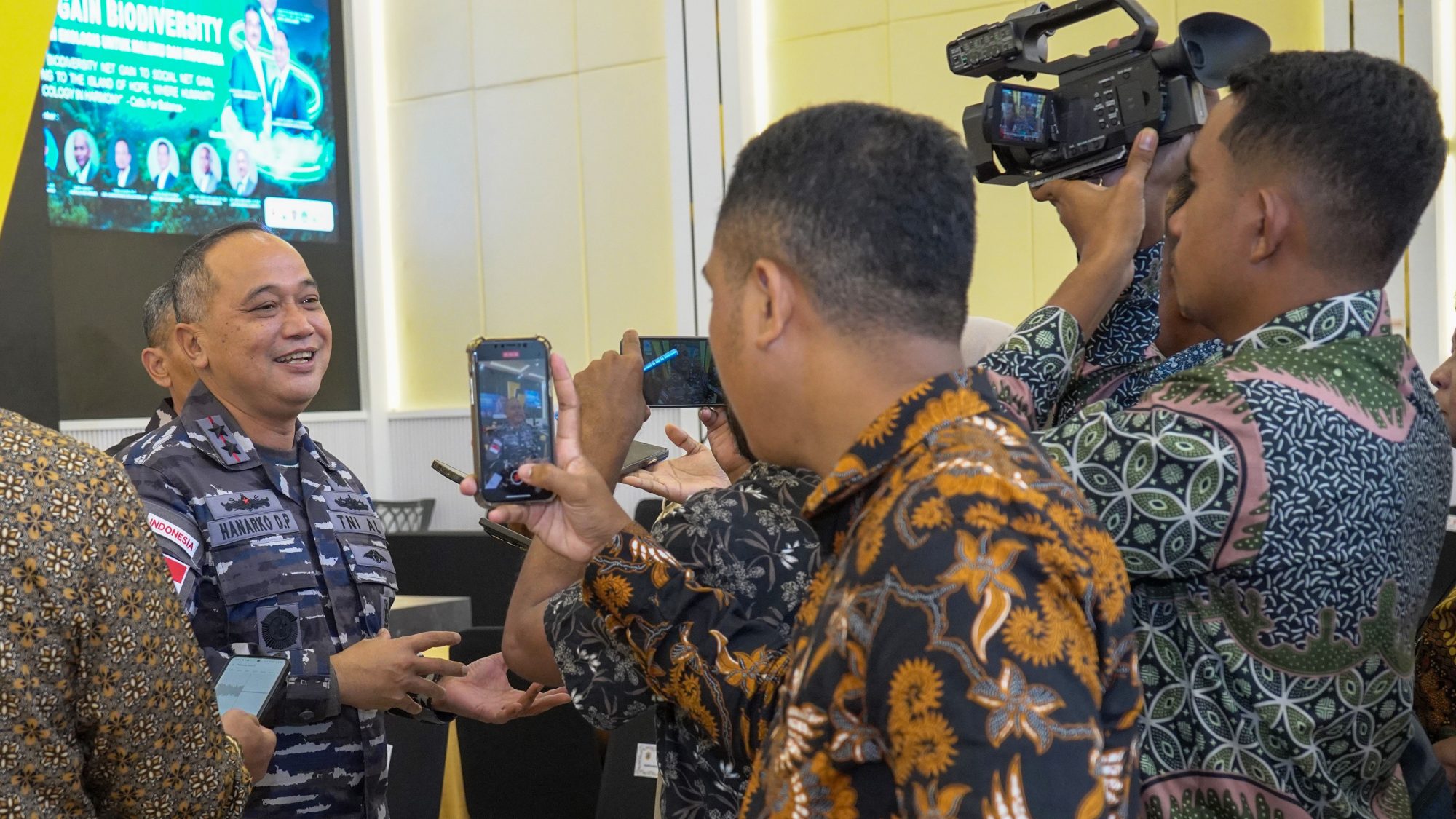

Protecting the sea means protecting people:
Blue Security as Indonesia’s path to a sustainable maritime doctrine.
Indonesia is an archipelagic nation whose future depends on the sea. For millions of coastal communities, the ocean is not just a trade route or defense frontier—it is the source of food, protection, and social stability. Coral reefs sustain fisheries, mangroves shield coastlines, and marine biodiversity underpins livelihoods. When the ocean is damaged, the nation’s future is at risk.
The concept of Blue Security emerged from the realization that maritime security cannot be viewed solely through a military lens. The book Blue Security in the Indo-Pacific (2021) emphasized that ocean security spans legal, economic, social, and ecological dimensions. Its expanded edition in 2024 reinforced the message: protecting the sea means protecting people.
Recent figures highlight the ocean’s strategic role. The maritime sector contributes about 7 percent to Indonesia’s GDP, with millions of residents in more than 12,000 coastal villages depending directly on the sea. Safeguarding the ocean is inseparable from safeguarding the economy.
Since 2021, Blue Security has functioned as an analytical framework—a tool for academics and policymakers to interpret maritime security in a multidimensional way. Yet it has not been adopted as an official doctrine. The proposal now is to transform this framework into an integrative doctrine that unites civil and military strategies, ecological sustainability, and community welfare.
The urgency is clear. Pollution, illegal fishing, and climate change are eroding local economies. Fishermen lose income, coastal tourism declines, and poverty deepens. Blue Security reframes conservation as a poverty alleviation strategy: protecting ecosystems means sustaining livelihoods and reducing inequality.
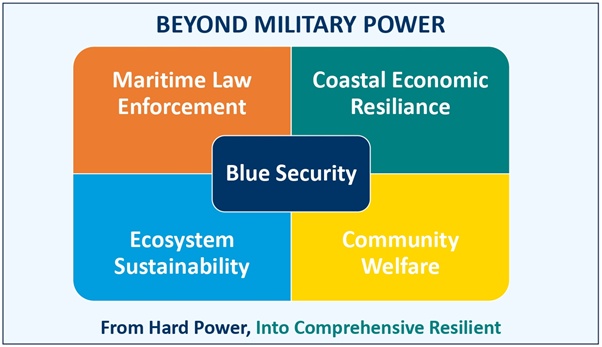
Maritime security cannot rely solely on warships. Civil–military harmonization is essential. Collaboration between the Navy, local governments, academics, and coastal communities builds legitimacy and strengthens policy effectiveness. Without public support, maritime strategy will falter.
Blue Security resonates at multiple levels. Nationally, it strengthens food and energy security. Regionally, it positions Indonesia as a leader in ecological-based maritime security in Southeast Asia. Globally, it demonstrates that ocean security is inseparable from sustainable development and the achievement of the SDGs. By prioritizing ecosystems, community welfare, and civil–military harmony, Indonesia signals readiness to face full-spectrum threats—from traditional military challenges to non-traditional risks such as climate change and illegal fishing, and even hybrid threats in the digital era. Blue Security is Indonesia’s new maritime vision for the people, affirming its identity as a resilient archipelagic nation committed to sustainability.*HH**