
By: Hanarko Djodi Pamungkas, Advisor of the Garuda Di Lautku Initiative Foundation
Indonesia’s Geomaritime Momentum
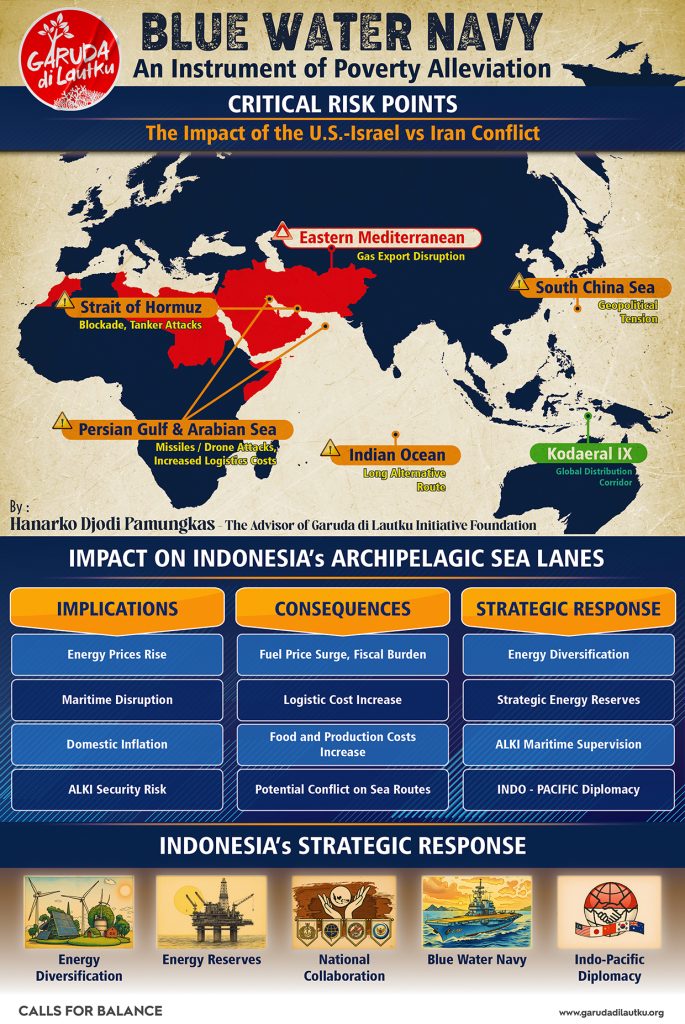
The ongoing conflict between the United States, Israel, and Iran has created significant uncertainty regarding global energy stability. Tensions in the Gulf and the Strait of Hormuz, which have historically been vital routes for global oil trade, have triggered energy price fluctuations, the threat of supply disruptions, and shifts in international trade routes. This situation emphasizes that maritime security is not merely a military issue, but a foundation for global economic prosperity. For Indonesia, as an archipelagic nation with an Exclusive Economic Zone (EEZ) through which more than 40% of global trade passes, this dynamic presents a crucial Geomaritime Momentum. Naval transformation is a strategic necessity to ensure the smooth flow of vital global energy and goods, while strengthening Indonesia’s position as a guardian of global trade routes.
In the western region, trade routes through the Straits of Malacca, Sunda, and Lombok serve as primary routes for energy and cargo ships from the Middle East to East Asia. Meanwhile, in the eastern region, trade routes through the Makassar Strait, Banda Sea, Arafura Sea, and Maluku Sea are increasingly strategic as global energy and mineral corridors, particularly with the growing role of Australia and the Pacific in commodity supply. By securing these two axes, Indonesia not only ensures the stability of international trade but also affirms its role as a guardian of global trade lanes. This momentum opens up a significant opportunity for Indonesia to connect global interests with the national agenda, making the sea a bridge between international security and the well-being of its people.
Indonesia’s Economic Impact
As a net oil and gas importer, Indonesia remains vulnerable to global energy price swings. Geopolitical tensions in the Gulf particularly the US-Israel conflict with Iran have intensified uncertainty, with disruptions in the Strait of Hormuz driving up import costs, widening the trade deficit, and eroding public purchasing power through higher fuel and electricity prices.
This dependence on global energy routes highlights the need for stronger maritime security. By safeguarding trade lanes within its Exclusive Economic Zone, Indonesia can ensure smoother energy distribution, reduce logistics costs, and ease domestic price pressures. Strengthening the naval fleet also opens opportunities to diversify energy supply, bolster bargaining power in long-term contracts, and enhance investor confidence in Indo-Pacific stability.
In this way, maritime security becomes not only a geopolitical necessity but also an economic strategy protecting national welfare from the shocks of global energy volatility.
Maluku: A Strategic Indo-Pacific Node
Maluku’s position at the crossroads of international trade has elevated it into a key hub for energy, food, and logistics security. The Abadi Masela LNG project anchors Indonesia’s energy diversification, strengthening its bargaining power in global diplomacy while reducing reliance on supplies from conflict-prone regions.
At the same time, the National Fish Barn (LIN) and Saumlaki SKPT reinforce Maluku’s role as a center for marine protein. Strong maritime surveillance curbs illegal fishing, while coastal communities gain better access to domestic and global markets.
The Maluku Integrated Port (MIP) is designed as a logistics hub linking energy and food corridors to international trade, cutting logistics costs and boosting Indonesia’s export competitiveness. Together, these initiatives position Maluku as a strategic node—bridging maritime sovereignty with equitable prosperity, and advancing Indonesia’s brand as a global maritime axis.
The Blue Water Navy: An Engine for Poverty Alleviation
Indonesia’s naval transformation into a Blue Water Navy is more than a defense strategy—it is a catalyst for socio-economic growth. Expanding long-range fleets, bases, and maritime infrastructure stimulates shipbuilding, logistics, and marine services industries, creating jobs and empowering coastal communities.
By integrating fishing cooperatives, vocational training, and certification programs into the maritime supply chain, prosperity is distributed more equitably. Secure trade routes maintained by the Navy lower logistics costs, stabilize prices, and boost export competitiveness. These benefits reach not only major industries but also small communities reliant on affordable food, energy, and transport.
In this way, the sea becomes a platform for both security and social justice, positioning the Blue Water Navy as a structural engine for poverty alleviation across the archipelago.
Indonesian Maritime Diplomacy
Indonesia’s maritime diplomacy recognizes the sea as more than a defense frontier. It is a platform for development diplomacy that links national interests with regional stability. The transformation into a Blue Water Navy positions Indonesia as a strategic actor in the Indo-Pacific, capable of shaping outcomes rather than merely absorbing the impacts of global conflicts.
With expanded naval capacity, Indonesia can deepen multilateral cooperation to secure sea lanes alongside ASEAN partners and strategic allies such as Japan, South Korea, China and Australia. This strengthens international legitimacy while opening opportunities for investment, energy diversification, and inclusive trade.
Ultimately, Indonesia’s maritime diplomacy underscores that naval power is not about military expansion, but about bridging security with social justice turning the sea into a foundation for collective prosperity..*HH**