

THE SEA THAT FEEDS, THE SEA THAT FADES
Marine Protein and Global Fish Stock Status. The ocean plays a critical role in global food security, supplying over 17% of the world’s animal protein intake—a vital contribution to nutrition, particularly in coastal and island nations (FAO, 2024). However, this essential resource is under increasing pressure. According to the latest assessments, 35.5% of global marine fish stocks are classified as overfished, meaning that fishing activities exceed the rate at which populations can naturally replenish, threatening long-term ecological and economic sustainability (FAO, 2024; Global Seafood Alliance, 2025).
Despite these concerns, there are signs of resilience and responsible management. Approximately 64.5% of global fish stocks are currently exploited within biologically sustainable limits, reflecting progress in fisheries governance and ecosystem-based approaches (FAO, 2024). Moreover, when measured by catch volume, 77.2% of total global landings originate from stocks considered biologically sustainable, indicating that a significant portion of the seafood consumed worldwide still comes from well-managed sources (Blue Life Hub, 2025).
SEASPIRACY: THE FISHING INDUSTRY AS THE PRIMARY CONTRIBUTOR TO MARINE DESTRUCTION?
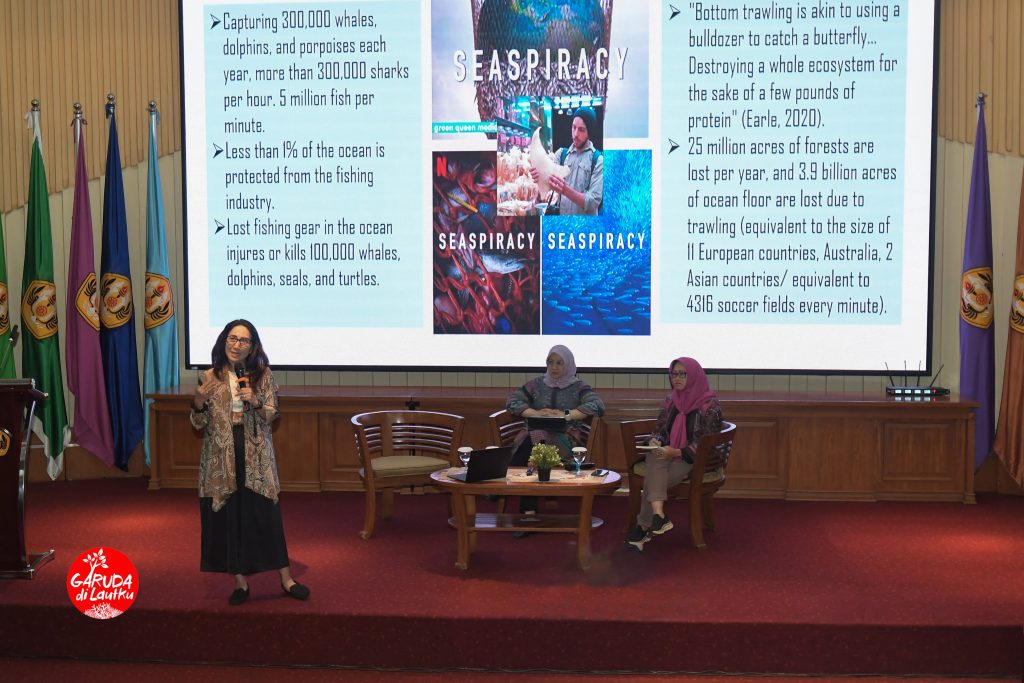
Each year, over 300,000 whales, dolphins, and porpoises are unintentionally captured in fishing operations, making entanglement the leading cause of death for these cetaceans. The scale of extraction is staggering: more than 300,000 sharks are caught every hour, and approximately 5 million fish are harvested every minute, reflecting the intensity and efficiency of modern fishing fleets. Despite the ocean covering over 70% of the planet’s surface, less than 1% is effectively protected from industrial fishing activities
Bottom trawling, a widespread industrial fishing method, is increasingly recognized as one of the most destructive practices in the marine environment. As oceanographer Sylvia Earle poignantly observed, “Bottom trawling is akin to using a bulldozer to catch a butterfly… destroying a whole ecosystem for the sake of a few pounds of protein” (Earle, 2020). Bottom trawling is responsible for the degradation of an estimated 3.9 billion acres of ocean floor—an area equivalent to 11 European countries, Australia, and two Asian nations combined, or roughly 4,316 soccer fields every minute.
LEAKING OCEAN VALUE
Indonesia possesses one of the world’s richest marine ecosystems, with a Maximum Sustainable Yield (MSY) estimated at 12.01 million metric tons per year, and a Total Allowable Catch (TAC) set at approximately 8.4 million metric tons annually. These figures reflect the country’s substantial capacity to support a productive and sustainable fisheries sector. However, this potential remains underutilized and compromised by systemic inefficiencies and governance challenges. One of the most pressing issues is the prevalence of Illegal, Unreported, and Unregulated (IUU) fishing, which is estimated to cost the nation between Rp 30–60 trillion annually, equivalent to 5–7% of the national fisheries GDP. These losses stem not only from direct resource theft but also from the erosion of trust, market distortions, and reduced long-term viability of fish stocks.
Compounding the problem are misdirected subsidies, which often fail to incentivize sustainable practices and instead reinforce extractive behaviors. The lack of traceability across value chains and low-quality fisheries data further exacerbate the leakage of ocean-derived value, making it difficult to enforce regulations, monitor stock health, or design effective interventions. In essence, Indonesia is not lacking in fish but it is losing value. The gap lies in governance, compliance, and data integrity, not in biological capacity. Addressing these issues requires a multi-pronged approach: strengthening institutional frameworks, investing in data systems and digital traceability, reforming subsidy mechanisms, and fostering participatory compliance across stakeholders. Such reforms are critical not only for economic recovery but also for achieving long-term sustainability, equity, and resilience in Indonesia’s blue economy.
BLUE ECONOMY: PATHWAYS TO SUSTAINABLE AND HIGH-VALUE FISHERIES
The sustainable utilization of ocean resources offers a powerful pathway to drive inclusive growth, generate employment, and enhance food security—while safeguarding the ecological integrity of marine ecosystems (World Bank, 2017). As global attention shifts toward ocean-based development, the ocean economy is projected to exceed USD 3 trillion in value-added output by 2030, supporting approximately 40 million full-time jobs under a business-as-usual scenario.
Key growth sectors include marine aquaculture, seafood processing, shipbuilding, and offshore wind energy—all of which present strategic opportunities for downstream industrialization and value chain expansion. However, realizing this potential requires more than market momentum; it demands robust regulatory frameworks, institutional coherence, and science-based governance. As emphasized by the OECD (2016), “growth requires strong regulation”—a principle that must underpin all blue economy strategies.
Crucially, the blue economy should not be reduced to conservation alone. It must be understood as a strategic industrial policy agenda that integrates environmental stewardship, economic transformation, and social equity. This convergence calls for cross-sectoral coordination, investment in innovation and traceability, and the empowerment of coastal communities as co-managers of marine wealth. Indonesia, with its vast maritime domain and dynamic coastal populations, is uniquely positioned to lead this paradigm shift—redefining ocean development not as extraction, but as regeneration.
TROPICAL EELS: HIGH VALUE SPECIES, HIGH GOVERNANCE DEMAND
Southeast Asian eel species, particularly Anguilla bicolor bicolor and Anguilla marmorata, represent a high-value commodity in global seafood markets. Export prices for A. bicolor bicolor can reach USD 40–60 per kilogram in Japan, underscoring its economic significance. If managed sustainably, Indonesia’s eel sector holds the potential to generate over USD 100 million annually in export revenue—positioning it as a strategic asset within the blue economy framework.
However, this economic promise is tempered by ecological vulnerability. All native Anguilla species in the region are currently listed as Near Threatened or Endangered by the International Union for Conservation of Nature (IUCN), reflecting pressures from overharvesting, habitat degradation, and unregulated trade. The biological status of these species necessitates precautionary governance and science-based management.
Compounding this challenge is the increasing scrutiny of global eel trade. The international commerce of glass eels (juvenile Anguilla) now falls under the purview of CITES Appendix II, requiring exporting countries to establish robust traceability systems and conduct Non-Detriment Findings (NDFs) based on stock assessments. These mechanisms are essential to demonstrate that trade does not compromise the survival of wild populations.
Indonesia’s native eel species, particularly Anguilla bicolor bicolor, present a compelling opportunity to position eels as a flagship species within the national blue economy agenda. This potential is contingent upon the establishment of transparent governance across stock assessment, aquaculture development, and trade regulation. When these pillars are effectively integrated, eels can exemplify a model of high-value, sustainability-driven marine resource management. Ultimately, the case of eel illustrates a core tenet of the blue economy: that economic value cannot be decoupled from scientific governance and supply chain transparency. Eel fisheries and aquaculture, when governed responsibly, embody the principle of “value through sustainability” transforming ecological stewardship into long-term economic.
Presented at the Seminar "Strengthening the Governance and Downstreaming of the Eel Industry as a Basis for Formulating a National Policy on Sustainable Fisheries" Bale Sawala, UNPAD Jatinangor Campus, November 13, 2025